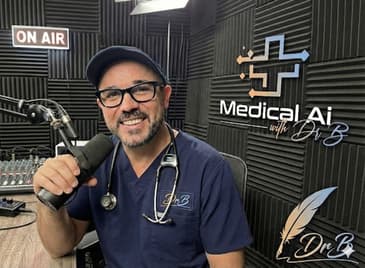
Welcome to another episode of The AI-Ready Doctor. In this episode, host Dr. Hassan Bencheqroun sits down with his guest and student, Aditi Chitre, to dive into the transformative role of artificial intelligence in medical education. From personal stories about AI “hallucinations” to innovative initiatives at UC Riverside, their conversation explores how generative AI and custom GPTs are reshaping case-based learning for future physicians.
They share thoughtful perspectives on skepticism, responsible AI use, and the importance of community, especially for a generation shaped by rapid technological change and the pandemic. Together, they unpack real-world challenges and lessons from integrating AI into their study routines, including chatbots designed to nudge students toward clinical reasoning instead of simply handing over answers.
Touching on topics ranging from AI companions and mental health apps to balancing life as a medical student and marathon runner, this episode challenges the myth that students turn to AI just to cheat. Instead, it reveals how today’s learners are building healthier, more productive relationships with technology and with each other.
Join us as we explore how the next generation of doctors is becoming truly AI-ready: embracing innovation while staying grounded in what it means to be human.
00:00 Case-Based Learning in Medicine
03:23 "AI-Powered Learning Support Chatbot"
09:22 "AI Empowering Global Learning"
12:44 "AI Builds My Running Plan"
14:16 AI's Role in Medical Education
19:25 AI Apps for Support & Moderation
22:12 "Tailored Tools for Efficient Studying"
23:52 "My Instance: Speaking to AI"
27:49 "Balancing Boards and Life"
Navigating AI in Medical Education - Insights from “The AI-Ready Doctor”
In the latest episode of "The AI-Ready Doctor," host Dr. Hassan Bencheqroun and student Aditi Chitre dive deep into the evolving landscape of artificial intelligence (AI) in medical education. As future physicians grapple with new technologies and learning paradigms, the conversation provides a candid look at both the promise and pitfalls of integrating AI within a medical curriculum. Here are key insights from their engaging discussion.
1. Healthy Skepticism: AI Hallucinations and Academic Integrity
The episode opens with Aditi Chitre sharing her own experience of being “a victim of believing something that the AI kind of hallucinated.” She recounts a moment where AI-generated citations turned out to be nonexistent, reminding listeners about the critical importance of double-checking AI outputs, especially in academically rigorous contexts. This episode’s honest admission drives home the message: While AI can be remarkably helpful, medical students must adopt “a certain healthy level of skepticism.”
2. AI and Case-Based Learning - The UC Riverside Approach
The hosts discuss an innovative initiative at UC Riverside, where AI is actively integrated into case-based learning for medical students. Dr. Bencheqroun highlights how case-based learning is pivotal for preclinical students, providing a bridge between textbook theory and real-world practice. Unlike some medical schools that shy away from encouraging AI, UC Riverside not only welcomes it but empowers students to use AI tools responsibly.
Aditi Chitre describes a student-led initiative to create an AI chatbot for case-based learning, designed to prompt students to think critically rather than simply providing answers. The chatbot helps guide reasoning by nudging students to consider different disease processes and systems, fostering deeper engagement. This approach is nuanced and clearly prioritizes thoughtful learning over shortcut solutions.
3. Embracing Progress Without Losing Authenticity
What’s striking is the generational attitude toward AI. Aditi Chitre reflects that “you can’t help progress wash over you,” yet students are mindful not to let AI substitute their learning experience. The sense of community that AI fosters at UC Riverside is counter to stereotypes that digital tools create isolation. Instead, students unite around shared interests, using AI as a supplement, not a replacement, for genuine learning.
4. Balancing AI with Student Wellness
Beyond academics, the conversation takes a personal turn as Aditi Chitre discusses running as an outlet for stress and emotional decompression. Interestingly, she leveraged ChatGPT to develop a personalized training plan for a half marathon , illustrating how AI can be seamlessly woven into both professional and personal spheres.
Yet the dominant theme remains balance: how to use AI in ways that augment, rather than undermine, one’s growth as a future physician. With med students making a conscious choice not to use AI for shortcutting their development, the attitude is clear: “you’re only cheating yourself, right, out of being a better doctor, a better physician.”
5. Faculty Concerns and National Competencies
The hosts address faculty apprehensions that AI might encourage academic dishonesty. Aditi Chitre acknowledges the concern but points out that medical school students, having chosen this demanding path, are intrinsically motivated to use AI responsibly. The call for structured AI literacy is timely, with organizations like the AAMC building national competencies for the ethical and effective use of AI in medical education.
6. Tailored Tools and Prompt Engineering
Finally, the discussion underscores the importance of using specialized AI tools and mastering prompt engineering. By focusing on platforms like AMBOSS that are tailored to board exam content, students ensure more reliable and productive study outcomes.
Ending Thoughts
Episode #15 of "The AI-Ready Doctor" presents an inspiring and pragmatic look at how today’s medical students are shaping the future of AI in education. The episode celebrates skepticism, community, and mindful adoption of technology. For medical educators and students alike, the message is clear: AI is a powerful tool when wielded thoughtfully and the next generation of doctors is ready to meet this challenge head-on.
https://www.linkedin.com/in/drbmedicalai/
https://drbmedicalai.com/med-ai-academy/
“Disclaimer: Informational only. Not medical advice. Consult your doctor for guidance.”