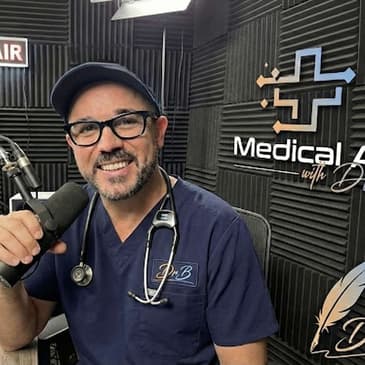
Welcome to another episode of The AI-Ready Doctor podcast, where we explore the intersection of technology and compassionate healthcare. In today’s coffee talk, host Dr. Hassan Bencheqroun sits down with critical care nurse leader Mary Lawanson-Nichols to tackle the timely and complex topic of AI in nursing. Together, they discuss how artificial intelligence is rapidly transforming healthcare, from the promise of reducing documentation burdens to the very real concerns about job security, loss of critical thinking, and the human connection at the patient’s bedside.
Drawing on personal stories, professional insights, and even lessons from films like Hidden Figures, and examine fears and opportunities facing nurses as AI becomes an everyday reality. They consider the vital role nurses play in patient safety, the frontline risks of alert fatigue, and the importance of AI literacy as both a shield and a tool for maintaining the profession’s trusted role. Whether you’re a nurse, physician, or healthcare innovator, this episode will challenge you to think about how we can empower clinicians to shape technology, rather than be shaped by it for a future where human judgment and compassion lead the way.
00:00 Learning and Concerns About AI
06:14 Nurses interpreting AI alerts
09:34 AI's Role in Healthcare
12:26 AI literacy in nursing
14:44 Balancing AI and critical thinking
21:05 Nurses as healthcare safety monitors
24:20 Nurses' decision-making challenges
26:59 Using AI in nursing tasks
29:45 AI tools for nursing tasks
35:03 Discussing AI's role in decision-making
37:56 Pacing and privacy concerns in AI
39:43 Balancing emotional sharing and details
45:57 Embracing AI in nursing
46:59 Discussing AI in healthcare partnership
AI in Nursing: Empowerment, Caution, and Why Human Connection Still Matters
In a recent episode of the “AI-Ready Doctor” podcast, host Dr. Hassan Bencheqroun sat down with critical care nurse Mary Lawanson- Nichols to dive deep into the evolving relationship between artificial intelligence and nursing practice. Their candid conversation offers a rare blend of optimism, realism, and heartfelt advocacy for the irreplaceable role of nurses,not just as implementers of technology but as guardians of patient care in the AI era.
The Double-Edged Sword of AI in Nursing
When asked about nurses’ perceptions of AI, Mary cuts to the heart of the matter. There's excitement and anxiety in almost equal measure: some nurses fear AI could make their roles obsolete, while others dream of AI as a tool to ease documentation burdens and allow more time for bedside care. “Nurses are doing just charting 40% of their day…when does that leave time for care at the bedside?” Mary wonders 02:14, highlighting a core frustration AI could help address.
Yet, she’s also clear about the aspects of nursing that should never be automated: human interaction, intuition, and the art of reading the room. Even quiet, sedated patients sense the presence and touch of a nurse, she notes. This, Mary insists, is the soul of nursing that technology must not erase 04:29: “That human interaction, connectedness…That’s what being in the medical field is.”
AI as an Ally, If Nurses Lead the Way
Dr. Hassan Bencheqroun draws a parallel with the film “Hidden Figures,” asking if nursing needs its own moment—one where nurses, like the film's protagonists, proactively learn and adapt to new technology rather than being left behind 08:57. Mary responds that nurses have always adapted to new tech, sometimes even using AI tools without realizing it. But the pace of change with AI is daunting, and she underscores the importance of nurses being part of the process, not passive recipients of top-down change 10:58. “We need to be on board…or get left behind.”
Both guests agree: AI literacy should be seen as a shield, empowering nurses to critique, challenge, and influence the growing presence of these tools in their workflows. Far from replacing nursing, AI if shaped by those who use it can elevate the profession.
What Makes Nurses Uniquely Vigilant
One recurring insight from Mary: nurses are poised to be the “AI safety monitors” of healthcare 21:05. Their continuous, holistic patient assessments mean they’re often the first to notice when the outputs of a model clash with clinical reality or when an algorithmic suggestion risks patient safety. “We’re actually the last person that it goes through before it gets to the patient in a lot of instances,” Mary says 21:50.
This unique positioning, however, comes at a cost. When AI recommendations conflict with clinical judgment, nurses can experience profound moral distress caught between trusting their hard-won intuition and following confident machine advice. Mary vividly describes reliving difficult decisions, questioning whether she did the right thing for her patients 24:20.
Practical Use Cases and Persistent Concerns
What should nurses do right now to engage with AI safely? The answer, both agree, lies in cautious experimentation. Mary uses AI for practical tasks like reformatting documentation or quick clinical lookups, always paired with due diligence and verification 43:15. She likens AI to “asking a girlfriend for advice” just one perspective, not gospel 32:09.
Yet, concerns persist: the potential for AI to deskill nurses, miss context, add documentation burdens, or become an instrument of surveillance 13:56. Mary is emphatic that AI should serve as a support, not a replacement for critical thinking: “Treat the patient, not the machine” 15:17.
The Path Forward: Courage, Training, and Humanity
To new nurses, Mary offers a pep talk: “Stop being a chicken, get out there and start using [AI]. It’s okay. But you need to have due diligence.” 45:48 To nurse leaders, she urges structured training, not fear or hype 45:22.
Perhaps Dr. Hassan Bencheqroun captures the episode’s spirit best: “I want the future nurse to supervise AI agents, to notice, to question, to translate, and to protect.” 46:33
In the age of algorithms, the nurse’s watchful presence carrying the story, the nuance, the humanity remains irreplaceable. AI is here, but the art and heart of nursing must always lead the way.
https://www.linkedin.com/in/drbmedicalai/
https://drbmedicalai.com/med-ai-academy/
“Disclaimer: Informational only. Not medical advice. Consult your doctor for guidance.”
When we're talking about AI and healthcare, we're talking about algorithms and doctors and models and documentation. I want to bring the nurses in the middle. And I want to say nursing is not just task completion. It is navigating care. It is reading family dynamics. And sometimes it is patching up between the doctor and the family. And you're the line in between. Mary, you are not just a phenomenal critical care nurse at a prominent urban university-based hospital, but you also derive a lot of purpose from mentoring and leading and teaching. So welcome to the podcast.
SPEAKER_03Thank you so much. I've been very much looking forward to it. So I'm going to be calling you Dr. B if that's okay, unless you'd like me to call you Hassan.
SPEAKER_01Either way, whatever is comfortable for you, my viewers and my listeners know me with both. Okay. So today, what we want to um raise the awareness and the discussion, and we're going to be talking about in a sort of a coffee talk, uh, just you and I discussing, as we discussed before, AI in nursing. And boy, is it a moment for nurses at this time, isn't it? Tell me what you're thinking about when you hear about AI in healthcare, and the nurses are trying to find their way into AI.
SPEAKER_03You know, um, I have, I have to say, I've learned so much, and I tell you this of AI. When I came to you, I was a baby AI person. You know, the crawling and everything. And it has helped me open my eyes when I'm talking to staff. Nurses are are really concerned. They're concerned that they're not going to have a job. AI is getting them out of a job. They're going to have to look for other things. But then there are other nurses saying, I wish we had AI, because then they could go ahead and I could dictate my notes as I'm thinking about it, and it would be in the chart. I wouldn't have to be typing. And we found, as we've looked at nurses, they are doing just charting 40% of their day just in charting. So, and in some instances, even more than that. When does that leave time for care at the bedside? What we were trained for with the patients. So I think it's a double-edged sword. Some people are afraid, some people are wishing for it. So it would alleviate some of the stressors and things that are taking them away from patient care.
SPEAKER_01I love that you dived right in because it isn't that you are just hearing about AI. You've been thinking deeply about AI. It's not a shiny object, it is reality. It is not just a dashboard, it's something that got deployed before anyone got trained in it. And everyone is training sort of the best way that they can. So you're not just thinking about it, you're asking about it in a better question. So let us sort of talk a little bit about this. Usually, when I hear talk about AI, I'm guilty about it myself. When I first started the podcast, it says the AI Ready Doctor. It was for doctors. And when I started my medical AI Academy first web series, I put it for the busy doctor. And then this year my eyes opened. My dad is in the hospital, and the nurses are every single minute of every single day. So when we're talking about AI and healthcare, we're talking about algorithms and doctors and models and documentation and bill-in. I want to bring the nurses in the middle. And I want to say nursing is not just task completion, it is navigating care, it is reading family dynamics, and sometimes it is patching up between the doctor and the family, and you're the line in between. So let me ask you this when you think about the critical care nurse of the future, what should never be automated?
SPEAKER_03I feel very strongly that interaction with the patient. Now, and I say that, and people say, in the critical care, they're sedated, they're not moving, they're not talking. How are you interacting with the patient? Well, you know, we have to remember as critical care practitioners, we're taking all the data we get, touching, seeing, feeling. And that's what I'm saying about the interaction. But I don't want us to forget that even though patients are sedated, maybe they're not talking to you, maybe they're not reacting to you. They can still hear you, they can still hear what you're doing. And you have um stories or even in literature saying where patients couldn't talk because they were sedated or they were paralyzed, and they're hearing people coming in. They're not doing anything, they just hear little footsteps, then they feel people touching them, then they're just manhandling them, then they're starting to poke them. And that's what I mean about interaction. We really can't give that away. That's what being in the medical field is, is that human interaction, um, connectedness. And I just don't want that to go ahead and go to the AI way. Now, granted, we can use AI in helping us remind us of stuff, helping us to say, okay, go ahead and do this assessment. Um, go ahead and take a look at this. But for me personally, as a critical care nurse, I don't want that to go to AI.
SPEAKER_01What I hear from you and what I've experienced as a patient, as well as a family of a patient, is that the nurses carry the patient's story across shifts, across teams, across charts, and across families. Because when we say and the ambient AI hears distended abdomen, it can mean many things. It can be abdominal compartment syndrome, it can mean ascites, it can mean ileus, gas distension, many things. The AI picks up on the words, but the nurse picks up on the vibe. It's the nurse that interprets what AI has summarized. And so I think that even now, as we look at predictive analytics, an alert comes in. We have learned that alerts in the ICU, there's noise pollution, and there is alert fatigue. It's the nurse that interprets the alert, whether it belongs to real life or not. So while AI can count the drips, the nurse is what who can tell you something feels off in the room. Now, we have discussed how the nurses are critical, pun intended, for their patients. But a lot of the nurses are saying, Is it gonna replace me? And I couldn't help. You and I discussed the movie, um, and the movie was the movie Hidden Figures. Uh, there's plenty of really good actors there, Taraji Henson and Kevin Costner and others. And it was in back in the day in NASA, and there was a group of the ladies, and they were the stenographers and the shorthand and secretaries, and they brought this huge, huge machine, and the men at that time were learning the computer. And one um uh Octavia Spencer went, or her character one time saw that computer and was going on her off time to read the manual, and then brought the ladies to study the manual with her. And one week they were gonna get rid of them, and they couldn't figure out a problem, and she happened to be around and says, This is the solution. And they turned perplexed and said, How do you know? Well, we know about the computer, and there was a dramatic scene in the moment where the ladies are moving from one building to the other. They were gonna get sacked that week because they didn't know them. The computer computed all of the secretarial jobs until they became savvy about the computer, and suddenly not only did they not lose their job, they became purposeful in their new job. So it isn't that the jobs will be lost, they will change. So I guess the question that I have it's not whether AI is coming for nurses, but the machine is being rolled into the hospital. Who's going to open the manual? Does nursing need its own hidden figure moment with AI?
SPEAKER_03You know, I think uh one of the things I want to bring up is that we have AI models going on all the time, even years and years and years ago. We just didn't know it. So, say for instance, if um I can I can say there's a prominent um electronic medical health record company that has an analytic that goes in the background and it lets nurses know what's going on. That's AI. And it wasn't until I was talking with you and the levels. So the reason why I bring this up is we've been living in through AI. What more can we do? Do we need a hidden figure? It's hard to say because how fast is AI going at this moment? Do we need a hidden figures? I would say we need to be part of the process, but a hidden figures, I can't tell you. And I think it's because AI is changing so rapidly. There are things coming out into AI, into the healthcare field, that it's almost faster than the new drugs that are coming out, keeping up with it. And I think that we as nurses, we learn something new every day. That's one of my mottos. We learn something. It doesn't have to be grandioso, it doesn't have to be uh life-changing. Something new you learn that you can pass on. So if you see that there is something in AI and they want you to test it out, I think you need to be on board because when that moment arises, you want to be able to say, Yes, I want to get on board with this hidden figures moment. Or it's gonna be, I don't want to get involved and get left behind.
SPEAKER_01So I love how you put it. The question isn't whether or nurses or not whether nurses will use AI. They already are. The question is you need to include it in all of the new things you're learning every day. You're learning about that new flow track, you're learning about the new IV pump that just got rolled out in the hospital, you're learning about the new ventilators, even though they are for RTs, you need to know a little. So it's not about becoming engineers, it is about being clinically fluent in AI enough to challenge bad tools. If an ambient scribe is deployed, if a new alert system of a sepsis score is deployed, I need to be able to understand what's under the hood so I can give my feedback. It only gives me that bad score when a CRP is there, but not when a procalcitonin. Or it only gives me a delirium score when there is a patient who has a different language than English. It only so it makes you question has it been studying patients like mine, or has it been studying other patients and deployed in my patient, therefore there's an error rate. So that's my vision for nurses is to have AI literacy become your shield for your job. Because I tell you what, of 25 years, 24 out of the past 25 years, the one job that still holds the general public's trust is a nurse, not an airplane pilot, not a finance, you know, counselor, not a doctor, a nurse. And so that is going nowhere because there is that human aspect of it. So that leads me to if we are nervous about AI, honestly, they should not be, but they should be alert because healthcare has a history of introducing technology that promises relief and and delivers, you know, uh, you know, delivery of salvation for a lot of things, but instead it delivered more alert, more clicks, less time at the bedside, and so we still have scar tissues from the electronic health record. And so when you hear an AI dashboard, literally our soul leaves our body for a quick break. So we want to honor the nerves. So my question to you is what should make nurses nervous and still be a legitimate concern when it comes to AI, you know.
SPEAKER_03Um I think giving a lot of the critical thinking to AI. And I say that in regards to when AI is prompting us as we speak right now, um, and really not taking the next step into critically thinking, what is it saying to you? And I and we have this saying, and you probably have heard it in critical care: treat the patient, not the machine. And if we are gonna go ahead and treat the machine and leave our patients behind, there are gonna be errors. And I think the biggest thing we need to go ahead and do as AI, because there's no stopping AI. AI is here, it is out of the gates, and it's it's the gates have opened up, the horses are running, and we can't get the horses back in. So let's get on the horse and start riding because we have to go with it. And I do think to me, that is the one thing I as a as a clinician wanting to make sure we don't lose that critical thinking, because that's what helps us tell the difference between AI, what it's been fed, and what we are seeing, feeling, that intuition that has actually been studied. And it is a factual um element that intuition from a clinician is can be just as good or even better than a computer generated. So I think the one thing we all have to remember is it's so easy to go ahead and let AI do some stuff. Oh, I'll just go ahead and let it look up stuff, but I don't validate it. Oh, I'll just go ahead and let AI um find a good restaurant, but we don't look at what the the reviews have been. Um and I'm just giving just random things that we let AI either see, or maybe I'm gonna just let AI give me the background on a disease and maybe leave out some key pertinent items. I don't know because I don't let it do it for me, but those are things we have to think about.
SPEAKER_01I have um queried various social media, such as Reddit and Twitter and Facebook, various discussion groups from nurses about fears. And I want you to give me a thumbs up or down. Do you agree? Do you disagree? Okay. AI nurses fear. Fear that it becomes a Trojan horse, a surveillance method. Thumbs up, thumbs down.
SPEAKER_03Thumbs up and it's it's just thumbs up and thumbs down, so I'm not gonna go ahead and interject, so you can go through it. So I'll keep it thumbs up. Okay.
SPEAKER_01Yes. Fear for more documentation burden. Thumbs down. Fear that AI will become another productivity weapon. Fear that AI will miss context. Yes, fear of de-skilling, which means that losing some of your skills to AI. Yes. Fear of being blamed when AI is wrong. Okay, so nurses are not anti-technology, they're just anti being what, voluntoled into broken technology? What do you think?
SPEAKER_03I think um, you know, it's not the technology, because technology has been around, and it is, I mean, if we just talked to a nurse that has been a nurse for 30 years, going through all the new technology that has come through her time as a nurse. So it's not the technology, in my opinion, it's the fast pace that it's coming upon us, and how much it's encroaching into every aspect of what we do as a nurse. And that's what I think is making people fearful from talking to them, interacting when we talk about AI. So the technology portion, that's something that they have to live with. They can't get away from it. That's healthcare, and that's what you you do with healthcare. It's the speed that this is coming on, and we have no control of the speed. And I don't think, to tell you the truth, that people have been fully uh taught on how to use it, and this is where some of the fear is coming from.
SPEAKER_01I would agree with this. So the question that I have is nurses, generally speaking, they are well, they're looking out for their patients, they're looking out even for their doctors, for their respiratory therapists and pharmacists. I have a post that I read on LinkedIn from one of the nurse influencer, I like to call them trusted advisors, they're not influencers. Um, that the first AI safety monitor in healthcare may not be an engineer, it just may be a nurse. So why are nurses uniquely positioned to catch AI mistakes?
SPEAKER_03I you know, I do think as nurses because we're looking at changes, changes in how the patient is progressing, changes in how they're medating, changes in An interaction with family, because even interaction can mean something, and we take all of that information in. And I do think we are poised in healthcare to go ahead and notice that and say something because we are the safety monitor. We're actually the last person that it goes through before it gets to the patient in a lot of instances. So we're taking due diligence of what we're doing, what we're seeing, how we're assessing, and making sure before it gets to the patient, we've done our checks and balances. So that's why I do think nurses are poised in that position to go ahead and be the one to monitor, to catch, to refine. Because once they monitor and catch, I tell you, it's going to be added to that AI knowledge, and it's going to refine how AI is doing whatever it is doing at that time to go ahead and do better.
SPEAKER_01To go ahead and do better. And what we're calling today is for all the nurses to feel empowered to lead the movement. One of such nurse leaders on LinkedIn that I follow, his name is Maxim Topaz, and super, super well-versed in AI in nursing, worked with the American Academy of Nursing regarding a position statement for AI intelligence in healthcare. And what his statement was that when AI recommendations conflict with clinical judgment, clinicians may experience moral distress. It isn't a fringe concern. It is now official policy language from the board of directors of the American Academy of Nursing. And we've spent years wondering if AI is going to replace us, but we did not even talk about how it's quietly reorganizing our work in ways nobody is measuring or governing. So what do you think about this particular angle, which is the moral distress when the AI output or the um if AI chooses something and we choose another, that clash, how is it going to be perceived, whether by leaders or by patients sometimes? Because AI's output is very confident. And so that may translate very different differently at the bedside. What do you think about the moral distress when there is discrepancy between the AI output and the nurse's instinct?
SPEAKER_03You know, right now, um nurses second-guess themselves as it is right now, because they want to do due diligence. They want to make sure they're not harming the patients. Um, I've had one nurse tell me the next day I was up all night because I wasn't sure what I did was right. Um, and even myself. I've had um one patient I still remember to this day. Um I got a physician order. I thought I was following it, but there was something I was missing, and they said, you missed it. And then I was replaying. Did I miss it? Did I do what's best? Did I harm the patient? Did I and I think in in from my opinion, and also with talking from everybody, I do think it's real because we want to do what's right, and we want to make sure that if we're going against something that is directing us, we want to know darn sure that we're on the right path before we step off of the the brick road and we go on to the dirt road. We want to make sure we're not we're not causing harm to patients. And I think we we we we have so much pressures from dealing with families, each other, interdisciplinaries, and making sure we've we've done what the hospital sets as standards for patient care. Now we have another item on top of it that falls into the mix that we have to go ahead and take into account. And then we have people that play it back. Did I do it right? Did I do it right? And this is where the stress can come from from did I do it right to why did I follow it when I had an inkling it was wrong, but I just went with what it said. And that's the other piece of it. If we go with what it says and it's wrong, and we don't check it out. So, I mean, there's two items there. We don't follow it, and then we have distress because maybe we should have. We did follow it, but we didn't do our due diligence, and maybe some um were thinking until we get that next assessment, or maybe you've done your three days, you don't see the patient for three days, and then you're lamenting for three days. Did I do this? Did I do this right? You know, that sort of thing.
SPEAKER_01So I guess because it is confident, it makes us question ourselves, and we have to assume that AI can be wrong. We have to ask AI for sources and verify those sources. We have to verify against our policy, our guidelines, our institutional standards. And we also shouldn't paste you know, PHI into public tools. We can use AI for drafts, but we have to check for final answers, and we have to build verification into the workflows. That is from a conversation that you and I had before. Now, give me some use cases that you could use AI in nursing because I want our listeners to take with them what they can use tomorrow. So when we use AI, I mean everybody thinks Chat GPT. So let's take the ChatGPT-like model and where can we use it in our first day? And I'll start with one example. Um, one example is, for example, if we had a uh AI that can search our institutional policies for a policy about the chest tube in a specific, you know, nurse's hands, and what is the scope of that nurse and that policy? You know, we spend a lot of time looking for policies when we have things that we have we don't do on an everyday basis. So, what other use cases do you see?
SPEAKER_03You know, I I see AI as an alert that they could go ahead and and give them at least areas that they could be alerted to. So, say for instance, there are very different disease processes that are not just the usual that you hear out in the public. Um say, for instance, most people may not know what Stephen Johnson syndrome is, and when you have that understanding what are some of the uses, if you could use AI to alert you, hey, when this symptom comes up, because you've looked at it and you're just asking it to do a uh a reminder of such. So, best case uses uses for nurses in AI as we see it now, with a chat GPT-like. Um, I think the biggest thing that people are using it for is looking up diseases to help them understand. Now, mind you, we always have to do our due diligence because there are other uh areas that you can look at diseases, but this can give you something quick, something easy. The other thing is is to actually take a look at how we can go ahead and maybe look at a particular uh product that you have. Um, right now people are using YouTube. Um, and YouTube can be hit and miss depending on um what facility it was uh made from. Um another thing is to go ahead and take a look now at maybe what is the best way to do something. So, case in point, um we had um we were taking a look at how we can change a dressing on a burn patient, and we were going back and forth. What do you think? So we put it into an AI and it gave us a hybrid, and it gave us something to think about to go ahead and do the treatment for this burn patient because we were trying to go back and forth of how not to hurt the patient. So those are just a few examples that come to mind that if you needed to use AI right now, what would be safe that the nurse would feel confident, albeit they're gonna have to do due diligence to take a look to make sure it's not telling you something false that it was fed? Or maybe it's not even giving you the full picture, but it's just one opinion. Is if you're asking a girlfriend, what do you think I look like? And you ask this girlfriend, what do you think I look like? And you ask this girlfriend, what do you think I look? AI is one of the girlfriends, you're just asking the opinion.
SPEAKER_01I love that. I want to give you one more time the thumbs up or thumbs down. These are some of the use cases I got from nurses on social media. Um shift handoff summaries. Yeah, um, simulation cases for nurse students. Definitely teach back scripts. Okay, goals of care in end-of-life conversations. Thumbs down, I agree with that one. Role play for hard conversations, and lastly, drafting patient portal messages. You're hesitating. I get it. Yep, I agree with you. So I guess um my question to you is now we're getting to the hard parts where the nurses feel uncomfortable. And in that, it adds itself sometimes to the moral distress. And I've learned in your midst, you and Olena, and she's hopefully going to be one of my guests as well, about the Schwartz rounds. Can you tell us about the Schwartz rounds? What are they, and how could AI help or not in Schwartz rounds?
SPEAKER_03So, Schwartz rounds are rounds that are talking about cases that were very challenging to the healthcare team. It doesn't have to be a very high profile or high or a difficult disease, it could be even just challenging families as you're going through the care. Maybe there were things that ethically had come up that it's it's bringing uh practitioners together, so it's really having an outlet for practitioners to talk about these challenging cases in a way that could be bounced off of others, and I do think in AI, this is actually an area where some of these are really high emotional cases. And if you have, and I'm going back to the girlfriend because let me tell you, in healthcare, we all have our girlfriends, our good people, we just bounce things off of each other. What do you think of this? How would you feel? Do you think um that we could go ahead and do something different? And AI could actually be that impartial entity that could actually give us some information, and it's not based upon emotion because we do have ideas based upon our background, our our upbringing, uh, what we've got, what we've been exposed to, it shapes what we go ahead and tell people. AI is basically what has been programmed, and a lot of programming so it could sit. But I do have to go ahead and say again, it's only as good, the output is only as good as the input, and you have to go ahead and make sure, just like if a girlfriend said, Oh, that doesn't look good, it looks good to me. I don't know what you're talking about. You so you have to take some um thought about what it's giving you, but it is an avenue.
SPEAKER_01So keeping your agency in the era of AI. So I have a suggestion, and I want you to modify this for nursing if you see that this isn't working, or sanction this if this is something that you can take. One of the things I say to my colleagues, physicians, is to suggest a seven, perhaps a seven-day plan, which is day one, pick one AI tool approved for personal non-PHI use. Day two, ask it to explain AI in nursing in plain language, or ask it to give you a reservation at a restaurant in plain language, or ask it to, I don't know, why is this light on my car engine is on. Day three, ask it to rewrite a patient education with no identifiers. Day four, ask it to create teach back questions. Day five, test it against the policy or guidelines and ask it to read the entire 32-page and show where does it clash with it and where it could get you in trouble? Day six, use it for reflection after a hard shift without patient details. And day seven, um, write one paragraph on what helped, what scared you, and what you want nurses to keep control of. What do you think of the seven-day plan? What could you change? What could you keep? What would you add?
SPEAKER_03You know, um I think seven days may be fast. And the reason why I say that is depending on the person, you may have to digest what AI has said before you go on to something else. So, one thing I would go ahead and add is give it a day in between to go ahead and digest before you go on to the next thing. You may want to go ahead and maybe take a look and do some digging. That's just a suggestion. Um, I do like that you've added in items that are personal, professional, and beyond. I think the one thing that we may have a challenge with is de-identifying. That's my biggest fear. And because hospitals and PHI is really big on it because it can cause lawsuits. That's where I say it may be something that may need to be modified slightly, maybe given a scenario so that they could go ahead and maybe modify it themselves to fit something they've done. That's just a suggestion to help with that PHI item because I've been around a couple of people that it almost cost them their job. So I am really protective of my colleagues, but the patient's information as well, because you need a roof over your head.
SPEAKER_01So I love that you said that. I want to share with you an experience. I read an article once. I'm not smart enough to have come up with it by myself, but I read an article once where this physician said that she kept feeling unheard by her family. And whenever she comes from a very hard shift, the family just, you know, doesn't seem to get how hard it was on her morally. And one day when she said that to them, they said, Well, you don't share with us anything. And she came to the conclusion that they are right, but at the same time, how are we gonna share with somebody that I placed a central line and it caused a pneumothorax to somebody? And you have to explain all of this. And so for me, I said, Well, how can I work with this and find the middle ground? Sometimes we delve into the story, and all we want to be heard for is the emotion behind the story, and so instead of delving in the story, I started to say, I call, for example, my family, um, and say, How was your day? And I say to them, Today was hard. Oh, really? What happened? I didn't need to tell them the septic shock and the multi-organ failure and the four pressers. I just said, Today I told her a mother that her son is not coming home. That's it, that's the emotion that weighs on me, not the story behind it. And that conveyed the message without the PHI. So, this is where I found myself connecting this. So, in order for us to, I mean, time goes by fast when you're having fun, especially with a friend. I want to ask you in a rapid fire. Okay, and you can answer me with one word, but the most that it can be is one sentence. Okay, so I'm gonna ask you a question, and you can answer me in a rapid fire. One AI myth nurses should ignore.
SPEAKER_03AI myth a nurse should ignore. Wow. Oh that uh AI is your boyfriend.
SPEAKER_00Sorry, but it's a closing question. Yes.
SPEAKER_02Sorry.
SPEAKER_00Oh, we you have no idea. We're gonna have an episode just on that. It is superb, so it is superb.
SPEAKER_03So nursing-wise, um, a myth. Um, you know what? I think it's gonna be more so that um AI will always give you the right or the wrong answer. And I think it just depends on who you're talking to. So that's why I had to get a give a preface.
SPEAKER_01Wonderful. Thank you. One AI skill every nurse should learn.
SPEAKER_03They need to learn there's different AI tools out there.
SPEAKER_01Wow, okay. The there are different AI tools out there. Fantastic. And give me one AI use case you trust.
SPEAKER_03Use case I trust for me, what I've used AI for, and I do trust it, and right now it's re reformatting words that I'm gonna put down. So I give it the sentence and it reformats. I so I'll leave it at that for one sentence.
SPEAKER_01Reformatting, and I think you and I discussed how nurses could use it to lubricate some of the conflict that happens on a day to day, and how you can take the edge out of words that you use, whether with a family, whether with a Colleague or with. So reformatting. I love that. One AI use case that makes you nervous.
SPEAKER_03Diagnosing or in in nursing wise, it would just be a differential diagnosis of a patient. Because we don't diagnose as nurses.
SPEAKER_01Excellent. I love that. One thing nurse leaders must stop doing.
SPEAKER_03In regards to AI, I think putting out there that AI is the bad guy in healthcare right now.
SPEAKER_01Beautiful. One thing nurse educators must start teaching.
SPEAKER_03How to use AI appropriately around nursing.
SPEAKER_01Amazing. One sentence you would tell a new grad nurse about AI.
SPEAKER_03You can use AI, but you need to use your critical thinking on what it's giving you.
SPEAKER_01I was hoping you'd say that. I love it. One sentence you would tell a chief nursing officer.
SPEAKER_03We need training on AI for our staff if it's in the hospital now.
SPEAKER_01And lastly, one sentence you would use you would tell about AI to young new grad nursemary.
SPEAKER_03Stop being a chicken. Get out there and start using it. It's okay, but you needed to have due diligence.
SPEAKER_01I love it. I do. I sincerely love it. Listen, this has been amazing. Thank you for bringing the conversation back to the bedside. Thank you for helping me elevate nurses and bring in the word AI and nurse in the same sentence without fear and without confusion and without nervousness. It is about protecting the parts of nursing that should never be buried behind, I don't know, alarms and dashboards and metrics and clicks. I want the future nurse to supervise AI agent. And I want the future nurse to notice, to question, to translate, and to protect. Because the Lord knows I see nurses and I'm so grateful for what they've done for me and for what they've done for my father and my family. So let me ask you for one closing thought.
SPEAKER_03You know, um, I've said this before, and I think I've said it to you, that um in healthcare we are a partnership in how we care for patients. And I I feel very fortunate that we have physicians like you who are looking at us and not just looking at how AI can help their physician area, but can help the next portion of healthcare interdisciplinaries, the nurse, and how we can use the tools that are out there, but how we can safeguard against it. And um, it's it's been a very fun ride with you. Um, in that again, I just want to say thank you for sharing your knowledge because I was the scared person. I wouldn't even it when somebody said chat GPT, I said. Now, I know a little more. I don't use Chat GPT, I use others, but I want everybody else not to be afraid. Embrace, but make sure you're critically thinking. So thank you, Dr. B, for bringing us along into this new world of technology. That we it's here, we need to go ahead and embrace it.
SPEAKER_01You're amazing, and I sincerely love you. I think the future nurse uh will still do what nurses have always done, and that is indeed protect the patients, even if it means costing them their job or costing them their day. So let's remind ourselves that the patient is not a data point with a wristband, it is a human being, and their story merits to be carried, and the nurses do it best. Curiosity is infectious, catch it here at the AI Ready Doctor Podcast. See you next time.