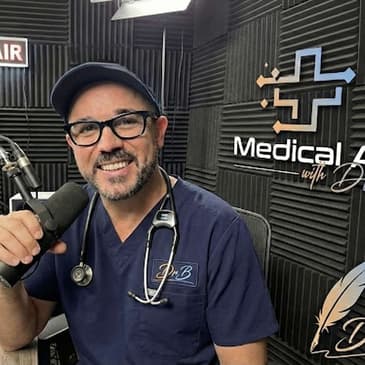
Welcome to this episode of The AI-Ready Doctor, where technology meets compassion in modern healthcare. Today, our host Dr. Hassan Bencheqroun sits down with an exceptional guest, Dr. Chima Melton, a board-certified pulmonologist, intensivist, and entrepreneur with roots in computer science and business management. Together, they dive deep into Dr. Chima Melton's winding journey from investment banking to frontline critical care, including her pioneering work launching a tele-ICU company that brings expert care to underserved hospitals.
In this episode, you'll hear how tele-ICU transforms patient outcomes through remote expertise, and how AI is becoming a trusted partner from ambient scribes that streamline documentation, to advanced decision-support tools helping critical care teams respond faster and smarter. Dr. Chima Melton and Dr. Hassan Bencheqroun also tackle the ethical challenges of AI in medicine, exploring biases in datasets and the crucial need for human oversight.
You'll get a behind-the-scenes look at the real impact of tele-ICU through a personal story, learn which AI tools are shaping daily life for physicians and families, and hear practical advice for clinicians navigating this fast-evolving landscape, even if you don't consider yourself a techie.
If you are curious about the future of critical care, working smarter with AI, or just finding ways to protect your presence for your family, this episode offers a blend of inspiration and insight from two leaders at the crossroads of medicine and innovation.
00:00 "Journey Through Medicine and Leadership"
04:37 "Tele-ICU: Remote Critical Care"
08:17 "Sister's ICU Survival Story"
12:34 "AI Copilot for ICU Care"
14:37 "AI Bias and Ethical Concerns"
18:23 "Bias in AI and Healthcare"
21:13 Human-AI Collaboration in Medicine
26:55 "AI-Powered Interior Design Success"
29:21 "AI Boosts Hospital Care Quality"
33:09 "AI's Environmental Challenges"
34:57 Navigating Barriers in Patient Care
38:22 "Grateful Appreciation to Dr. Bey"
The Power of Tele-ICU and AI: A Conversation with Dr. Chima Melton
The latest episode of The AI-Ready Doctor podcast is a must-listen for anyone curious about the future of medicine, as host Dr. Hassan Bencheqroun welcomes his colleague and friend Dr. Chima Melton. What follows is a wide-ranging, deeply insightful conversation about career pivots, the rise of tele-ICU, and how artificial intelligence is reshaping the healthcare landscape, from the boardroom to the ICU, and even to the living room.
A Journey Fueled by Adaptability
Dr. Chima Melton’s path into medicine is anything but linear. Born in Nigeria and raised in the UK, she started her career in computer science and risk management before pivoting to medicine. She recounts her journey through Yale, Cedars-Sinai, UCLA, and eventually founding a tele-ICU company a testament to embracing change and lifelong learning. Her story embodies a spirit of adaptability, illustrating that diverse experiences are powerful assets in tackling today’s complex healthcare challenges.
What is Tele-ICU? Debunking the ‘Robot Doctor’ Myth
Many still imagine tele-ICU as a “robot doctor” scenario, but Dr. Chima Melton sets the record straight: tele-ICU is about bringing critical care expertise to hospitals lacking in-house intensivists. It doesn’t replace bedside teams instead, it layers expert support on top of the existing staff, bridging gaps in knowledge and bolstering safe, accountable care. It’s about leveraging technology AND human expertise, not choosing one over the other.
Her compelling story about Melina, a mentee-turned-office-manager, illustrates the tele-ICU impact at a personal level. Melina’s family experienced first-hand the value of remote expertise when her sister was in the ICU. Without tele-ICU, the outcome might have been very different. As Dr. Chima Melton puts it, the most scarce resource isn’t technology, but attention—the human capacity to synthesize data and make nuanced clinical decisions.
How AI Is Transforming the ICU—One Workflow at a Time
A major thread throughout the episode is the practical integration of AI into critical care. Forget distant speculation, Dr. Chima Melton and her team have used AI scribes in tele-ICU for years. These tools handle time-consuming documentation, freeing clinicians to focus on what matters most: patient care. She underscores that while AI scribes can get 85-90% of notes correct, attentive human clinicians must always review and tailor them, to guard against errors and “hallucinations.”
Beyond documentation, AI is now being deployed for decision support. It sifts through imaging, labs, and physiological data to issue early warnings when patients begin to deteriorate a potential game-changer for outcomes.
Dr. Chima Melton also envisions a near-future where AI acts as a true “co-pilot” in care, integrating multimodal data and helping shape clinical plans, not just summarizing records.
Risks, Bias, and the Indispensable Human in the Loop
Both guest and host repeatedly reinforce: AI is not a panacea. The risks of alert fatigue, false confidence, and critically bias in training datasets can lead to harm if we’re not vigilant. Dr. Chima Melton stresses that algorithms trained on populations unlike one’s own can exacerbate disparities, highlighting the urgent need for clinicians to remain skeptics and critical thinkers.
At the same time, AI protocols can, in some cases, help reduce human bias, especially in standardized care pathways. The trick is knowing when to trust, and when to question.
AI as a Life and Work Partner
Away from the ICU, Dr. Chima Melton is just as enthusiastic about AI's impact on daily life, from calendar coordination to interior design, she even used Gemini to create the perfect room at home. But she’s clear-eyed about the privacy tradeoffs and the environmental footprint that powers every AI search.
Final Takeaway: Stay Curious, Stay Engaged
For anyone feeling overwhelmed by the pace of change, Dr. Chima Melton’s advice rings out: stay curious and engaged. You don’t need to be a technologist to be “AI-ready”,just keep an open mind, ask questions, and remember, “Nothing for us, without us.” AI will shape the future of healthcare, but its best work will always be in partnership with thoughtful, present clinicians.
https://www.linkedin.com/in/drbmedicalai/
https://drbmedicalai.com/med-ai-academy/
“Disclaimer: Informational only. Not medical advice. Consult your doctor for guidance.”
The scarce resource right now is attention and presence. When we are talking about AI, yes, it would be integrated in your life, but it should have the benefit and aversion of success where it's not just making you more effective and productive. The goal is presence. The goal is attention.
SPEAKER_02When you talk about telec, we're not talking about taking away the humans and just having computers and a remote doctor watching. We're talking about an additional layer of support on top of the existing team, on top of the existing infrastructure.
SPEAKER_01With me today is someone I'm privileged to call friend, boss, colleague. I'm proud to have as a guest today Dr. Chima Melton. She is a board-certified pulmonologist, intensivist. She went to undergrad in computer science and management, trained at Yale, did fellowship at Cedars, and worked at UCLA, where she also got an executive MBA. Talk about multi-talented. Dr. Chima Melton, welcome to the AI Ready Doctor Podcast.
SPEAKER_02Thanks for having me, Dr. B. I am super thrilled because I know we've talked about this for about a year now, and finally it's happening. So so happy to be with you today.
SPEAKER_01It is a pleasure. So I want to start us by tell us how you got to where you are right now and what's one thing important for our listeners to know about you.
SPEAKER_02Yeah, so it's a long journey. I'm not going to take you through all of it because it's uh kind very windy. Um, but I'll give you the highlights, which is basically, you know, I grew up in the British countryside in um Nigerian originally. Um well, you don't stop being Nigerian, it's it's in your blood. Um, a British Nigerian. And um I spent most of my formative years in the UK. I come from a pretty large family. And um, when I was in my 20s, early 20s, I moved left in the UK and moved to the States. Um, my undergraduate, as you mentioned, was in computer science with a minor in management. And so I was going down a very different pathway um rather than doing a medicine. Um, I actually worked in risk management and investment banks, both in London as well as in New York. And um I think for me, my journey has really been marked by the ability to pivot and be very adaptable in new situations. And so, you know, did that for a few years, realized it wasn't for me, realized I wanted something more in life in terms of helping humankind, you know, as a lot of us physicians do. And so I went back to school and did a postbacular program because I did not have the prerequisites to do medicine. Um I was in St. Louis, Missouri, uh washi, which was a very interesting situation. If you've been to St. Louis, you'll know exactly what I'm talking about, um, especially as a person of color. It was it was very curious to be there. Um, and so, you know, did my um I did my uh post bacular program there, um, spent a little bit of time in California applying for med school, and then eventually got into one in New York. So I did, I was at Stonybrook Um University, School of Medicine, where I met my husband, now husband, and um the rest is history, med school, residency at Yale, as you mentioned, um, and then continued on to the West Coast, which is where I now live, um, where I was in fellowship at Cedars. And then I spent eight years of faculty at UCLA. Um, during my time on faculty, it was really marked by um, again, change, um, understanding that clinical medicine was fantastic. And at the same time, I wanted change on an organizational level, um, which is what prompted me to go and do the executive MBA at UCLA and then transition to more leadership um positions within UCLA. Um, at the time I left, I was quality medical director in the Department of Medicine and telehealth medical director. Um, and I left because I basically started my own tele ICU company, and which you're aware of, and I've been running that for about five years now. So that's the sort of short story as to where I am professionally now.
SPEAKER_01That is phenomenal. It's a representation of how a physician can meet their oath that they took towards their patients in more ways than one. It could be in a boardroom, it could be in front of a camera, or it could be on a one-on-one in an exam room or in the ICU. You mentioned tele ICU. Most of our listeners, when we meet them, you and I, in conferences and we say tele ICU, people just have a hard time. They shake their head, they tilt their head, they look at you and say, what is that, a robot ICU? What what how do you take care of patients in a tele ICU? So uh share with us a little bit what is tele ICU?
SPEAKER_02Yeah, I think at the very basis, tele-ICU is using telehealth as a modality to care for patients. And it's very broadly encompassing. It could refer to the technology, specifically in the case we're talking about, we're actually talking about the human knowledge, i.e., freeing the physician from having to stand physically at the bedside, the intensivist who's expert in um critical care, and allowing them to actually practice remotely and perform really high quality care for the most complex patients, um, regardless of where they are. So that's what I talk about specifically when I mean tele ICU. As mentioned, though, it's very broad, right? So it involves not just the human knowledge, but it also involves the technology pieces of it, the management of the ventilators that can actually be done remotely as well. Um, titration of drips, monitoring vital of vital signs, physiological factors that can also be done remotely. Um, so these are all the different components that involve are involved when someone talks about telecritical care or tele-ICUs.
SPEAKER_01And when we talk about tele-ICU, can you define with us what is the model? Who's watching? What are they watching? How do they communicate? And what does success or failure look like in tele-ICU?
SPEAKER_02Yeah, so you know, the one thing I always try and preface this conversation with is that when you talk about teleIC, we're not talking about taking away the humans and just having computers and a remote doctor watching. We're talking about an additional layer of support on top of the existing team, on top of the existing infrastructure. So imagine a community hospital, because it tends to be smaller community hospitals or even moderate-sized community hospitals where there is no in-house intensivist. There is nobody who's board certified to care for these critically ill patients. But you have everybody else. You have the primary hospitalist by the bedside, seeing the patient, managing the patient. You also have other consultants, you may have a cardiologist there, you'll have a surgeon, you have the ED. So everybody is there. But this particular niche knowledge is missing. So if you think about layering that on top of an existing case, what you're providing there is actually safer, more accountable care because you have evidence-based expert care being practiced on top of the care that the current team is delivering.
SPEAKER_01And we have in our midst one of our star champions, Melina, and she met you and TeleICU in a personal story. I know that she allows us to share that story. Can you tell us a little bit about Melina and how did she come to know Tela ICU from the personal side before she came to work as an executive admin with us?
SPEAKER_02Yeah, so that's a fantastic point. And she is now the office manager. She got promoted last year, so you'll be clear. Um, so she actually um I was mentoring her, and um, you know, I knew her from a college access program, and she's very phenomenal. One day you should have her on the podcast and have her tell her her story because it really is a story of resilience. Um, so anyway, I know her through this college access program where I was her mentor. And one day I'm just seeing patience as I usually do. This is a few years back now, um, and you know, see a Spanish family, uh um Hispanic family, and you know the young lady's not doing great on the ventilator. And at the back I hear Chedenma off of camera, and I'm like, who is that? Because all the nurses call me Dr. Chima. And she she was like, it's Melina. She walks in on the camera frame. And I'm like, whoa, and she's like, yeah, this is my sister. And so from that point, you know, she basically got to see firsthand the work we do in terms of partnering, not just with the clinical nursing team that's like the respiratory therapist and the primary care, I mean, and the primary physicians hospitalist, in terms of really driving the ICU care and making sure the coordination is done. So the infectious disease doctors on board, the neurologist is on board, the studies that she's supposed to be getting are getting done. And also the medications are appropriate as well. Um, so she saw firsthand the management. And thank God her sister did great. She's doing fine today, you know, walked out of the hospital. Um, and we, you know, she after this, she joined the group, you know, and she's been with us for now about two and a half years. And um, yeah, it's it's it's it's a really lovely story because we saw firsthand how the work we're doing can really impact families.
SPEAKER_01And were it not for the tele-ICU, there would be no intensivist. It would just be reliant on everybody else, but no intensive care physician. Am I correct? That's exactly right.
SPEAKER_02And, you know, in 2026, we talk about AI, we talk about, you know, technology, etc., but the most guess resources attention. It's about the expertise and the time that it takes for someone to stop, review a clinical picture review, all the different things that are, you know, the components that feed into it, process that and make clinical decisions out of that. And to have an expert be able to give you the time to do that, that's really where the value is. That's a value proposition here.
SPEAKER_01So thank you for seguing into AI. How do you see or how do you integrate AI in your teleicu work?
SPEAKER_02Yeah, so what I'm going to talk about is what the current state looks like, and then we can talk a little bit about what the future state is going to look like. So the very easy, um low-hanging fruit, I'll say, which really allows us to scale very quickly, is allowing AI to do the some processes that were incredibly time consuming and not really a super value add in terms of our uh tele ICU workflow. What of course I'm talking about is the AI Scribes. This is something we're early adopters for. I've been using AI Scribes now for about, my group has been using AI Scribes now for about four years. So we're really the first ones on the ball there. Um, because what we realized is with the volume of patience we're seeing, with the fact that this rich text, full text communication is happening, it really lent itself very well to AI. Um and it you would be, you would think in a nerd, um, a busy environment like an ICU with alarms going off, you won't be able to pick it up. But it actually works really, really well because the first thing is that the physician has to be able to hear what's going on. And if I can hear, it means my AI scribe can hear as well, right? Um, that I'm able to communicate with the nurses, to be able to communicate back to me. So allowing that to come in and really help for new patients flesh out the notes, get it like 85, 90% done. Of course, the human element is always very important as well. Where we're reviewing the notes, we're making sure if there's pieces missing, we're adding them in, if there are pieces that were misheard or things that shouldn't be there, because hallucinations happen even within AI scribes. We're pulling those out. And also we are actually um tailoring the notes to best fit our um, you know, the outputs of best fit our practice as well. Um so that's something that we we have tens of thousands of hours now worth of um AI, you know, scribe work, and it's really helped improve the workflow. So that's again very low-hanging fruit. Um I'm gonna talk about some of the other stuff that you know it's really important, which is around decision support. Um, there are so much data that comes out of the ICU in terms of like the imaging data, in terms of the lab data, in terms of the physiological data, and exist on what exists on the market are um the um ability, the capability to actually review these um the physiological data with early warning alarms. There's a lot of commercial products available now to actually alert you to say, hey, this patient, based on the trends we've seen historically, this patient's heading in the wrong direction. You need to intervene early into that as well. And then, you know, I think one thing to think about in terms of the future of what AI could look like within TeleICU is AI as a co-pilot, a virtual copilot. So not just the documentation piece of it, but actually thinking about multimodal data, taking in all this rich data that we're seeing, how the patient is looking, taking in the imaging results of it, even things like the historical trends of how the patient's been performing, and actually using that to come up with a care plan as opposed to just using large language models. So it's a really exciting world, I think, that we're going into over the next year plus. Um, and it's happening as we speak.
SPEAKER_01Boy, thank you. This is um almost like a Star Trek style medicine. And as you said, this is incredibly amazing to live in this era. The question I have is anything that we do, whether it's a publication, we have a section called limitations of the study. Whether it is a procedure, we have risks, benefits, and alternatives. So, in terms of AI, where does AI create harm? Maybe through alert fatigue or false confidence or distraction? Can you give us some examples and maybe how you factor that in, incorporating it in your practice?
SPEAKER_02Yeah, that's a great question. And you've listed some of the things out there. I think the one that keeps me up at night is the ethical piece of it, the bias in AI. Because a lot of the training data sets that have been used and these commercial products are based off of, are not based on the communities that we serve in Los Angeles. They're just not the baseline. And so what you do, what you're seeing, it's you know, people like in Mayo Clinic and you know with no no no offense meant to them, but it's just not representative of what certain communities look like. And so what happens is that when you have AI models trained on SKU data sets, your the the outputs you're delivering are not going to be representative of your population as well. So you always have to have a very close eye and actually, in some cases, look at it with a lot of um, what's the right word, a lot of suspicion, right? The outputs are because it may not necessarily reflect what's truly going on with your patient. You know, a lady who is in the Midwest who comes in with abdominal pain um has a very different differential diagnosis for um a 24-year-old African-American woman who comes in to you know one of our hospitals with abdominal pain. It's just totally different. Um, so I think some of the um the training data sets are really the the bias is really what worries me in terms of how we're interpreting AI. And I think this is why it's so important to train the next generation of um of clinicians up in their responsible use of AI, right? Because if you're looking at the outputs of AI and taking that as biblical and actually implementing that without that, look at it to ensure that it actually makes sense for your population, you are gonna start hurting patients very quickly.
SPEAKER_01Incredible. I think you brought up something that is also you and I had spoken about a lot before, which is the bias in the data sets. And um there is a researcher, Dr. Chelle, uh Leo Chelle, who um published about how you could uh basically surmise the ethnicity of a patient just through the vital signs that are coming across in the ICU, or um creating um or making publications and and studies about perhaps the overuse of antipsychotics for delirium in a certain population, but it's actually perhaps a um uh language barrier, or the fact that these are populations that may need uh the support of family rather than you know keep them out of the ICU only in visiting hours. So our system is built slightly differently for different populations, and we have AI layered on top of that, magnifying those biases. So I really thank you for highlighting this because this is incredibly uh representative. Now, if you were to design an AI stack behind the Till ICU, uh what jobs would you delegate first? And I'm realizing this is a controversy because people are afraid of AI taking their jobs. So that is a double-edged sword where what AI stacks would you do as a business person? How do you address that people are afraid that their jobs will disappear?
SPEAKER_02Before I answer that question, I want to add one more point. And I think it's an important point to what you just mentioned there, because I think there's a lot of disadvantages that potentially come with the bias for AI. But the other piece of it is that there are actually some advantages because we as human beings, this bias comes from somewhere. We as human beings are intrinsically biased creatures as well. And I've noticed one thing that happens is, you know, from our um one thing that can happen is that there is a pathway to how you manage patients. So for example, a patient who's there with pain, we know, for example, this is well-published literature in the black population, pain is really poorly treated. And I see it happen all the time where you have patients, you know, I see just last week an African-American man doubled over in pain, and everyone's like, oh, you're seeking narcotics, and so he's on like one milligram of morphine, which was doing absolutely nothing for him. Whereas, you know, in terms of having AI coming up in some cases with treatment plans, where it's like, this is how you manage pain. This is a protocolized way of managing pain, regardless of what that person looks like. You know, I think in some cases the bias actually gets taken out of the um equation there. Um, so I think in turn in terms of what the first step, now addressing your question, um, in that AI stack would look like is the clinical reasoning pathways. And I I sound like I'm about to put myself out of a job here. But I'm not, because if you think about it, you know, I'm I was a bioinformaticist. I think once a bioinformaticist, you're always gonna be one clinical informaticist. Um the reality is a lot of what we do in medicine here is protocolized, right? We learn these with pattern recognition. We learn these protocols about how you manage patients. And often we deviate from the protocols uh with a fault, and often it's because of human biases introduced that fault that fault to it. So I think the first thing I would do is having these clinical pathways that we know are evidence-based and actually monitoring adherence to those clinical pathways, right? So we know the patient who has DKA fluids, entire da da da, making sure that that's adhered to, if that's not adhered to, you know, in terms of looking at the orders and the computer, the administered time, using that as the first piece of a quality RCA in terms of improving processes for that institution. Very low-hanging fruit. It's complex, but it's actually low hanging fruit.
SPEAKER_01I appreciate that. And I um it makes me think also where is our red line? What should we never um hand over to AI and keep it in the hands of humans?
SPEAKER_02Yeah. I think at the end of the day. The bottom part of it. Like just like you know, I'm driving you're driving around in Tesla. Yeah. Um, but you're driving around in your Tesla and you and it's doing, you know, the autopilot function, you know, self-driving, full self-driving mode. And at the end of the day, it realizes that that human input is super important because there are certain things it doesn't know. So it allows you at any point to take over the wheel. I think we have to have the same perspective when it comes to medicine. This is protocolized, we use pattern recognition, we get it, the AI is doing it. And at the end of the day, you have to have an experienced clinician there that is monitoring everything, that human in the loop that's monitoring everything to ensure that does this make sense for this particular clinical circumstance? Because 85% of the time, totally it makes sense. But guess what? Those red hearings exist, and it's not always going to be following that protocol. So you have to keep that human in the loop there.
SPEAKER_01So the way I hear it is AI won't replace intensivist, but it would replace wasted time, but at the same time as it's doing it, it should scan, but humans should decide. That makes total sense. The pivot that I'd like to make is to the human part of the teleicu CEO. How does AI fit in your life as a business owner, as a doctor, as a mom, and as just a member of the community?
SPEAKER_02Oh my goodness. I literally can tell you that for the last three years, there has not been a day that has gone by that I haven't used AI in some way. Really? Yes. It is fully integrated in my life. And that is from everything scheduling. I, you know, as I'm you know, you mentioned mother, I have two kids. I have my husband, he's working. We we have very, very busy coordinating calendars, um, ensuring that we we when we travel, coming up with what that agenda and is gonna look like. Um yeah, it's it's so countless. Almost every single activity that I do that interfaces with technology, and even the ones that do not, you know, I think AI has proven itself. It's just like when Google first came out. You know, everyone's Googling everything. That's it's really the next tool. It's the tool that we use to really act as a way of um simplifying and removing the wasted time that you would otherwise spend on tasks.
SPEAKER_01Phenomenal. Um, it makes me think of something you said, which is the scarce resource right now is attention and presence. So when we are talking about AI, yes, it would be integrated in your life, but it should have the benefit and aversion of success where it's not just making you more effective and productive. The goal is presence, the goal is attention. AI is only a tool, but kids know if you're there. So that's what are some of the tools that you use on a daily basis? Give us some examples.
SPEAKER_02Yeah, so um Notebook LLM, I think is phenomenal. Often I have to review and um process a lot of complex information. And I've just found that notebook LMM works really nicely with my usual, like, you know, especially if I'm running, and I'm like, okay, this I have this 50-page thing to review, and it's you know, being able to interface with it. And then if I need to later on, I can go back and just directly look at the false text and see what's going on. So that's that's huge. Um, obviously, Chat GPT, you know, we do a lot of that, and you know, Gemini, Claude, I Claude I started using for some research in terms of really looking at the analysis of data, and that's been really helpful. Um let's see. Oh I I Grok. Grok is in my car, it tells kids' stories when we're driving. It's great, you know. It's uh putting on the voices is always fun as well. Um, you know, everybody has the Google Homes and so Gemini is on that. So it's really fully integrated in our lives. And um, I think for me, kind of having for coming from a computer science background, I have a little bit of a like higher trust threshold for IT than a lot of people would. Um, I think the thing that you have to be aware of is that all of these things are great, but nothing's free, right? I'm very acutely aware that my information is being sucked in and processed um by these large technology companies. Um I think it's just sort of weighing up the risk and benefits for your use.
SPEAKER_01I think you had shared with me a story about a using Gemini to create a vision of how you wanted a certain room to be or a certain design to be. Could you share that with us?
SPEAKER_02Oh, yeah, yeah. Um, so I had an interior decorator. We've been trying, we moved into our home a few years ago and we've been trying to redecorate forever, and you know, I'm pulled in a million directions, it wasn't happening. So I eventually got an interior decorator, spent a lot of time sort of going through with her, coming up with, and I was just finding it wasn't landing. The ideas she was giving to me were not really what I was looking for. And I'm as I'm speaking with her, I'm actually getting a better idea of what it is I want. And so I actually started putting this all into Gemini, and it has a really amazing um uh they've all caught up now, but back at the time, Gemini's um image um engine was just far and above everybody else's. And so with that, it was actually, you know, I gave it the prompts, you an expert um world-class um interior designer um with the style of da-da-da-da-da-da-da, you know, and then you know, this and I took pictures of my room and then gave me uh, you know, an architecture digest um version of what my room could look like, you know, and it basically pulled in and gave me suggestions, and together we were able to, it's served as the interior designer. You know, we're able to design a really phenomenal room, which I shared with you. And maybe I'll send you a picture for your podcast folks afterwards as well. Um, and we're very happy with it, you know, um, and obviously saved us$20,$30,000 worth, if not a lot more, than that of design time. Um so that works out really brilliantly.
SPEAKER_01I love it. And lately they actually give you the links of where to acquire the items that are put in your picture. And it was, I did that actually, told me exactly where to buy it.
SPEAKER_02You know, I was like, where can I purchase this? And I'll go to the store and take a look at it, and it worked out great. So um there's a lot of things to be said.
SPEAKER_01Yeah. Incredible. Um, there is somewhat of a tradition that we have on the AI Ready Doctor podcast, which is a rapid fire. Um, we'll call it the lightning round today. So I'm going to share with you something, and if you wanted to just tell me briefly in a one-liner, what does it make you think of, or what is your response to it? So let's start with the first one. Tell us one AI myth in critical care that you're tired of.
SPEAKER_02The fact that it means that no doctor is actually thinking critically about what's going on with your loved one. Um the the reality is that it is gonna be the clinician, and if anything, the clinician may actually be able to think a little bit more deeply because the less um value, less complex tasks have been taken away from them in the same vein, AI agents in the ICU workflow.
SPEAKER_00Um so I think we've talked about a few of them.
SPEAKER_02I think one of the ones that I really would, you know, I'd like to see more of is using AI agents in terms of the quality. I mentioned my background um was in um ICU qual not ICU, but in quality um of care in the I in the hospital period. Um and so having AI agents as being able to really do the work that currently teams are doing of reviewing care and seeing whether or not it adheres to quality quality of care versus non evidence-based practice. I think that's something that's very simple that most hospitals should actually adopt.
SPEAKER_00Um one metric that actually matters for quality. I mean, that's a very broad question.
SPEAKER_02Um I think the simple one, to be honest, because so many different metrics can uh multifactored, meaning that it's really hard to change them. But I think the simple one is family um communication, right? That's I can see that's it's very close to your heart as well. That hits. No, but as a clinician, that is one thing I can control. It's hard, you know, you're being pulled in a million directions, but that is one thing you can control. How do you communicate with the family about what's going on with your loved one today?
SPEAKER_01I love that you brought that. As a family member, I am a fervent push for family communication. It makes a world of difference. Um, we need to bring the family as an active part of the care team. A tool that you love and a tool that you regret.
SPEAKER_02Oh um, yeah, well, I mean, I'm actually gonna just say chat GPT. Um, and it's the same one because I love it because it's so easy in terms of you know helping poor data, etc. But I regret it. I think that there almost has to be like an experience limit to start using ChatGPT and in and AI in healthcare, because one thing I do see is you know, a lot of trainees are coming in with these beautifully polished presentations, but it's clearly something that you know ChatGPT's put together. And, you know, 80, 90% of the time it's correct, but there are huge flaws in it. And I think you need to have that level of experience. You know, I think you and I are fortunate in that we didn't come up in the age of, you know, Chat GPT. So we're forced to learn things, understand what medicine is, and then you can apply that critical reason on top of what it is when you have an output from something like, you know, your ambient AI or Chat GPT or Gemini. Um, but if you don't have that background and you take everything that it says as gospel, that's that's a problem.
SPEAKER_01Um as they say, writing is thinking. And if you skip the friction of writing, the learning will suffer. So absolutely agree. A boundary that you set to protect your family time.
SPEAKER_02Yeah, um, for me, the nighttime routine with my kids is everything. It's why, you know, it's a special time. So regardless of whether I have calls or, you know, whatever's going on, that time for me, you know, is is really important and sacred. So I leave the phone upstairs, I go, you know, and and just spend time with them, read them a book, do our prayers together, and and then put them to bed. Um, so that's something that I don't let anything crouch into.
SPEAKER_01Two more. AI impact on the climate.
SPEAKER_02Yeah, this is uh, you know, I'll tell you what I know, but I'm certainly not the expert at this. There's a lot of people, you know, I went to business school with that are much bigger experts at it. But I think one thing we are removed from and don't realize that every time we do uh an a search, you know, um on AI, you know, we put a prompt in that there's literally thousands of kilowatts of power being used nationally and these large farms, these large server farms, power in this. And so it has massive impact on the climate. And I think as human beings, as you know, people living in the states, we need to be more aware of it. Um, it kind of reminds me of the industrial age when people were just spewing crap into the environment and thinking, oh, well, this is great, you know, it's free. There is no free meal here. And I think we've been so far removed from the effects of it. You know, we're seeing climate change happening, but it's almost like we're not really tying cause and effect, right? Um, so I think that there's better uh we as a nation, yeah, as a global community, need better education into what we're doing in terms of, you know, in terms of our AI use, in terms of these prompts, and actually what's happening that the tech, you know, tech companies are not really telling us right now.
SPEAKER_01And lastly, it's important in this latest conversation we are recording in February 2026 about consent for ambient scribes in the ICU. How do we explain AI involvement to patients and families with our jargon?
SPEAKER_02Yeah, I think it's a hard um thing to do. Um and I think sometimes when you add in the additional layer frequently, you know, in our work of um of language, you know, the language barrier. So we have technology, we have medical um proficiency issues, we have language barrier issues, and then we have the level of critical illness that the patient has as well, that often they are not even able to consent. Often it's gonna be the family um that's doing that. Um, so I'm not gonna sugarcoat, it's difficult. It's difficult to find the right words, but I think um the way, you know, the way I've been doing it is, you know, I'm using the tool that will help me with my documentation. Um your data is secure and your data is safe in how in how we're we're using it. And um it allows me to be able to focus on you more as opposed to doing right in. So I really just try and um talk to the patient about the the risk, the or the family about the risks and benefits of it as well.
SPEAKER_01Incredible. This has been the most fun. I wish to give you um the last perhaps concluding word in the format of if another physician is listening to us, perhaps a woman in medicine, perhaps a mother, and they're not interested in being a techie, they have not had a training as a bioinformaticist, what would you like them to hear from you today as a takeaway present?
SPEAKER_02I think the big thing to think about, regardless of who you are, is just staying curious. You know, I think it's very easy to feel almost like with the advent of EHRs, electronic health records, that oh, that's for other people. You know, it's not gonna affect me. And then obviously meaningful use passed and everybody had to use it. Um, and so I think the same thing is gonna happen with AI. And it's important you stay plugged in, you stay curious, and you stay relevant with what's happening, because the rates we're seeing change happen here, I think it's gonna be within the near future that we're gonna see some mandates in terms of how we are using AI in medicine, and that is gonna affect you. There's just no way it will not. So I think it's important to be aware of these tools, at least try and use these tools so that way it's not a huge shock to the system like the EHR was, you know, 20, some 25, 30 years ago.
SPEAKER_01Indeed, the PTSD is real, and a lot of people do not want to engage with it. So sharing with them that nothing for us without us, and the fact that we do not need to have a uh a technological degree to be able to use AI, just having a technologically open mind uh is fantastic. So I had the most fun talking to you right now. I think I could go on for more, but I truly, truly appreciate the trust and what you shared with us about your personal journey, your interaction with Tilla ICU, with AI in your life and as a business person. Thank you kindly.
SPEAKER_02Thank you, Dr. B. It's been a lot of fun.