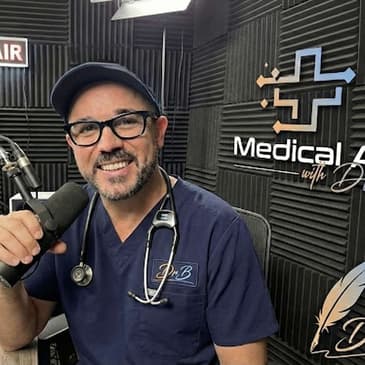
Welcome back to The AI-Ready Doctor Podcast! In this special episode, Dr. B introduces a refreshed format aimed at providing healthcare professionals with practical, usable knowledge about AI in medicine. Joined by the ever-curious Olena, a critical care nurse specialist, educator, and advocate, Dr. B dives into timely news stories highlighting both the promise and pitfalls of AI in healthcare, from insurance companies racing to implement algorithms to the real dangers of AI-powered scams. Together, they explore candid confessions and essential lessons learned from using AI in academic, professional, and everyday life offering listeners real-world strategies, new habits, and empowering tools to navigate the evolving landscape of healthcare technology with caution and confidence. Tune in for honest conversations, valuable takeaways, and a renewed sense of connection as we prepare to face the future, AI ready.
00:00 Podcast focus on AI in healthcare
05:11 AI in Insurance Industry
06:15 Healthcare industry challenges discussed
10:25 Friend's alarming phone call
15:39 Discussing ethical concerns as a parent
19:37 Figuring out AI together
22:07 Using APA format as a nurse
26:23 Checking AI-generated references
27:35 Incorporating AI into workflows
30:55 Language and cultural misunderstandings
34:59 AI reducing conflict in healthcare
39:09 Using AI for professional preparation
42:25 AI legal risks and engagement
45:44 Using NotebookLM for Nursing Practice
50:00 Creating asthma education content
53:45 Using AI creatively in nursing
57:17 Future of Transportation and Society
59:09 Olena's thoughts on AI in healthcare
Navigating AI in Healthcare: Lessons from the Frontlines
Artificial intelligence is reshaping medicine at a breakneck pace. In the debut episode of the new “AI-Ready Doctor Podcast” format, host Dr. Hassan Bencheqroun and guest Olena Svetlov, a critical care nurse specialist and educator, deliver a candid, energizing exchange on what it truly means to be “AI-ready” as a healthcare professional today.
Here’s a roundup of the standout insights and takeaways every clinician needs.
Not Just About Tech: AI’s Real Impact Is Human
The episode kicks off by reframing the mission: it’s no longer about convincing healthcare professionals that AI matters, it’s about separating real value from the “noise” (01:05). Dr. Hassan Bencheqroun emphasizes the need for usable, actionable knowledge that clinicians can apply right away, not just more hype and jargon.
Olena brings this to life by spotlighting how AI adoption isn’t merely a technical evolution; it triggers ethical, emotional, and practical ripples. Many healthcare leaders, she notes, are recognizing the potential pitfalls around dignity, security, and the essential human factor that can't be replaced by algorithms (06:11).
The Speed of Change and The Need for Caution
Both speakers call out a pressing tension: it’s not just AI’s capabilities, but the pace of their deployment, that is both intriguing and dangerous. Olena recounts a recent story involving insurance CEOs being encouraged to rush AI into claims and billing decisions. Even C-suite leaders, she reports, are warning that hastily introduced AI could introduce bias and erode humanity in healthcare decisions (07:45). As Dr. Hassan Bencheqroun asserts, “Balancing innovation with patient safety” must remain our compass, because “AI didn’t take an oath” (09:56).
New Threats: Emotional Manipulation and AI-Driven Scams
AI's ability to mimic human voices has given rise to “deepfake” scams, where loved ones’ cloned voices are used to deceive. Dr. Hassan Bencheqroun shares a harrowing story of a healthcare worker nearly falling victim. The lesson? Empower yourself and your loved ones with a simple verification system, like a passcode to counteract emotional manipulation (17:11). The core message: don’t just fear AI get smarter about its risks and defensive strategies.
AI Confessions: When Automation Goes Awry
A highlight of the episode is the “AI Confession” segment, where Olena openly shares her near-career-derailing experience. Having used an AI tool to format references for a scholarly article, she discovered only after submission, that several citations were entirely fabricated. The fallout was real and painful, but the experience yielded important lessons (24:58):
AI is a tool, not an oracle: Always verify AI-generated output, especially in high-stakes contexts like research and publication.
Mistakes aren’t career-ending, they’re learning opportunities: Sharing openly helps others avoid the same traps.
AI as a Communication and Empowerment Tool
The conversation shifts to practical wins: using AI to decode ambiguous English idioms and legalese, particularly for those for whom English is a second language. Olena describes using tools like Google Gemini and NotebookLM to instantly translate workplace jargon and laws, preparing her to lead confidently in complex meetings (38:29). AI, she enthuses, becomes a “pocket lawyer,” equalizing access to expertise and fostering inclusion.
The New Workflow: AI as a Sparring Partner, Not a Replacement
The podcast ends on an encouraging note: AI, when used thoughtfully, can deepen human connection and empower clinicians to bring their best selves to work. But vigilance is key, don’t surrender your judgment to the machine. Use AI “as your sparring partner,” Dr. Hassan Bencheqroun urges, to spot gaps in logic and strengthen your arguments, not to deskill yourself (44:01).
The Takeaway: Stay Curious, Stay Accountable
The message is clear. AI won’t take your job, but someone “AI-ready” might. Remaining relevant means embracing AI’s potential and its pitfalls with eyes wide open. Practice new habits, enforce new workflows, and, above all, preserve your role as a compassionate, discerning human at the center of care.
Before AI truly transforms medicine, we must shape how it’s used together, with integrity, optimism, and the readiness to learn. That is the heart of being an AI-ready doctor (59:55).
https://www.linkedin.com/in/drbmedicalai/
https://drbmedicalai.com/med-ai-academy/
“Disclaimer: Informational only. Not medical advice. Consult your doctor for guidance.”